
Rules Manager Node
The Rules Manager is the main interface for creating, editing and managing evaluation criteria which Catalyst uses to determine which browser opens each web application. This section contains details on the various elements of this interface.
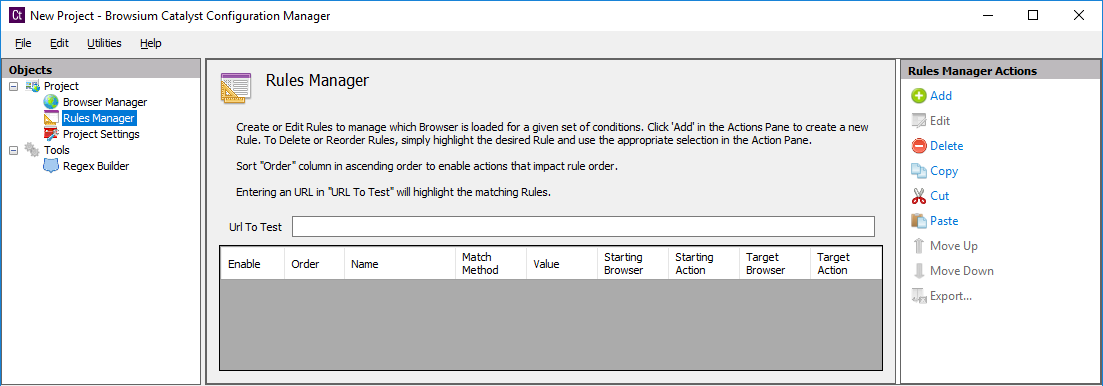
The Rules Manager shows the hierarchical rules list that Catalyst uses to determine what (if any) action to take when a web address is entered. The Url To Test box allows administrators an easy way to enter a given Url and see which Rule will be triggered by the value. The heading for each column in this window refers to the specific rule element for a given rule. The Rules Manager Actions pane will display the available options for managing rules.

Add — To create a new rule, click the Add link in the Actions Pane to bring up the Rule Editor window. By default, the rule will be added at the bottom of the list in Rules Manager. If you first select a rule in Rules Manager, the new rule will be added immediately below the selected rule. See the description of the Move Rule Up/Move Rule Down feature for more information on rule order. The Rule Editor section provides details on the options and values in the Rule Editor window. See the How to Create a Rule Section for details on creating rules.
Edit Rule — URLs and rule definitions can be complex, and complexity may lead to typographical errors. If you make a mistake or need to revise a rule, simply double click the line to edit (or highlight the line and click the Edit Rule link in the Actions Pane) to make the necessary changes.
Delete Rule — To delete a rule, select it from the Rules Manager Window, then click the Delete Rule link in the Actions Pane. To disable a rule, rather than remove it, uncheck the Enable checkbox.
Copy — To copy a rule, select the item from the Rules Manager Window and click Copy in the Actions Pane.
Cut — To cut a rule (which copies the item to the clipboard rather than delete it entirely), select the item from the Rules Manager Window and click Cut in the Actions Pane.
Paste — The Paste item in the Actions Pane can be used to paste items from the clipboard to the currently loaded, active project. For example, you can Copy/Paste items within a single project or Copy from one project and Paste into another.
Move Rule Up/Move Rule Down — Rules are evaluated in the order they are stored, so the sequence of rules can be critical to the proper functionality of your web applications in Catalyst. By default, rules are ordered in the sequence they are added. You can override this default by selecting a rule in Rules Manager prior to adding a new one. The new rule will be added immediately below the selected rule. To manually adjust the order of a rule, simply highlight the rule and use the Move Up and Move Down actions to move it to the proper placement.
Export — Saves the complete list of rules to a CSV file, with the following fields: Enable, Name, Match Method, Value, Starting Browser, Starting Action, Target Browser, Target Action. This file can be used to share information about the Catalyst rules with other members of the IT team. Note that Catalyst has no rules import function, so modifications to this CSV file cannot be programmatically applied to your Catalyst project file.
[]{#_Rule_Editor .anchor}
Rule Editor
Section titled “Rule Editor”The Rule Editor window is used for creating new rules or editing existing rules.
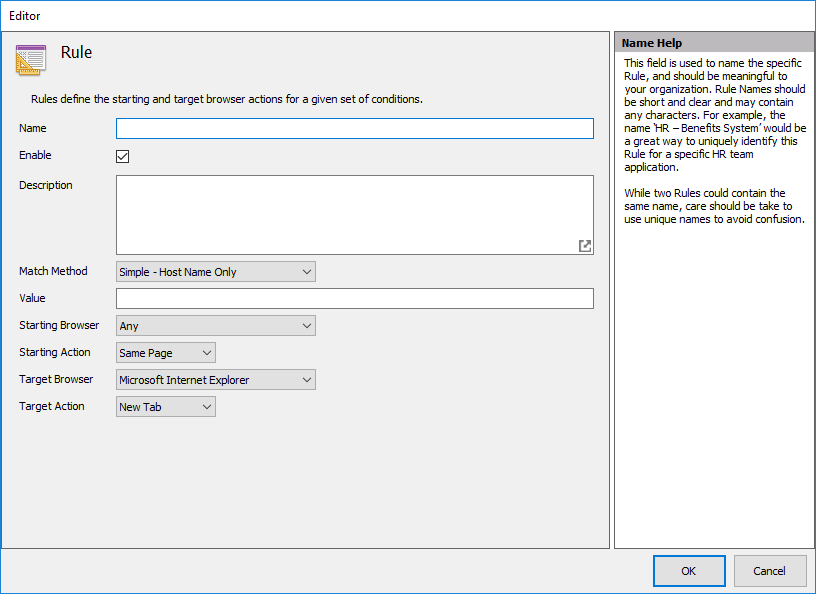
Name - You can name a rule using any characters without restriction or character count limit. Rule names are for your use and identification only, and have no impact on functionality. Browsium recommends using rule names that clearly describe what the rule is used for, so it can be easily identified in the Rules Manager display.
Enable (checkbox) - All rules are enabled by default when created. Some rules may contain complex parameters or complex paths and it may be more practical to simply disable a rule rather than remove it if the rule is not needed or to test ordering behaviors, etc. To disable a rule, click the checkbox to remove the check or click the checkbox next to the rule name in the Rules Manager.
Description - Many organizations will have multiple staff members working with rule creation and Catalyst configurations. To reduce confusion when working with multiple team members, the description field can be used to provide notes or even detailed explanations of the purpose for the given rule. Some organizations also require the owner of the rule to be identified in the description to streamline internal communications when a problem or question arises with a given rule.
Match Method — Most rules require a simple string match of the URL to trigger Catalyst to direct the navigation to the chosen browser. Some complex URL configurations require advanced pattern matching techniques, so Catalyst provides the ability to match based on regular expressions (RegEx) if needed. You may also use Zone as the match method so that rules are triggered based on the Internet Explorer Zone of the target web application.
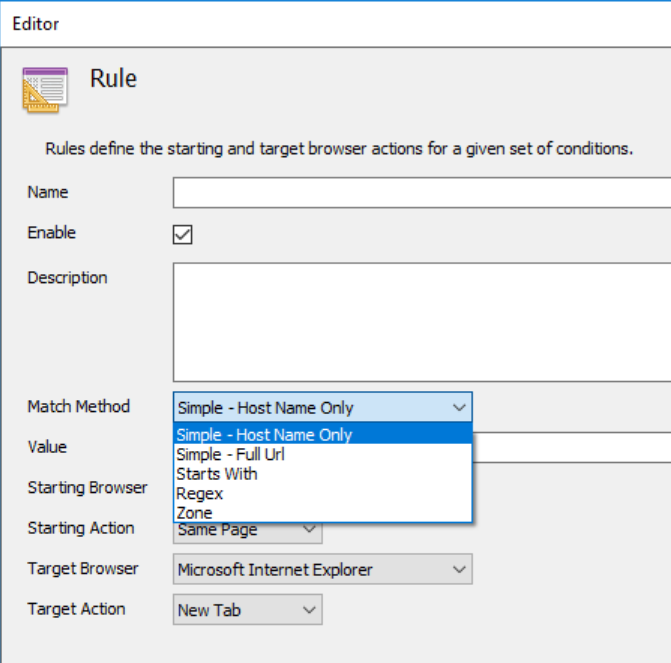
Rules can be set to trigger based on following types of pattern matching.
Simple — Host Name Only (default): Performs case-insensitive, substring matches on the Fully Qualified Domain Name (FQDN). E.g., will match “example” in http://www.example.com.
Simple — Full Url: Performs case-insensitive, substring matches on the entire Url including subpath AND query string.
Starts With: Performs case-insensitive, ‘starts with’ string matches. If provided, the protocols must exactly match. (e.g., http://www.example.com will not match https://www.example.com)
RegEx: Performs complex matching using regular expressions. Be careful to escape special characters such as periods.
Zone: Matches URLs that are in specified zones.
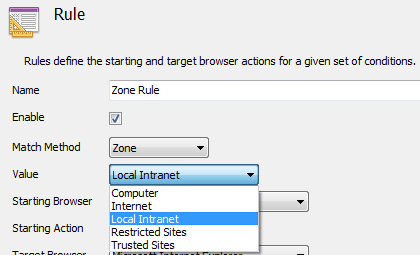
Value — This field contains the string or integer to conditionally match for a Catalyst rule to be triggered. If Match Method is set to Zone, the Value field will change to a dropdown menu containing Computer, Internet, Local Intranet, Restricted Sites, and Trusted Sites.
Starting Browser — This field determines which browser will evaluate the rule. The default is Any, meaning all browsers running the Browsium Client extension will evaluate the rule. A specific Starting Browser can be chosen so that Catalyst will evaluate the rule in that specific browser.
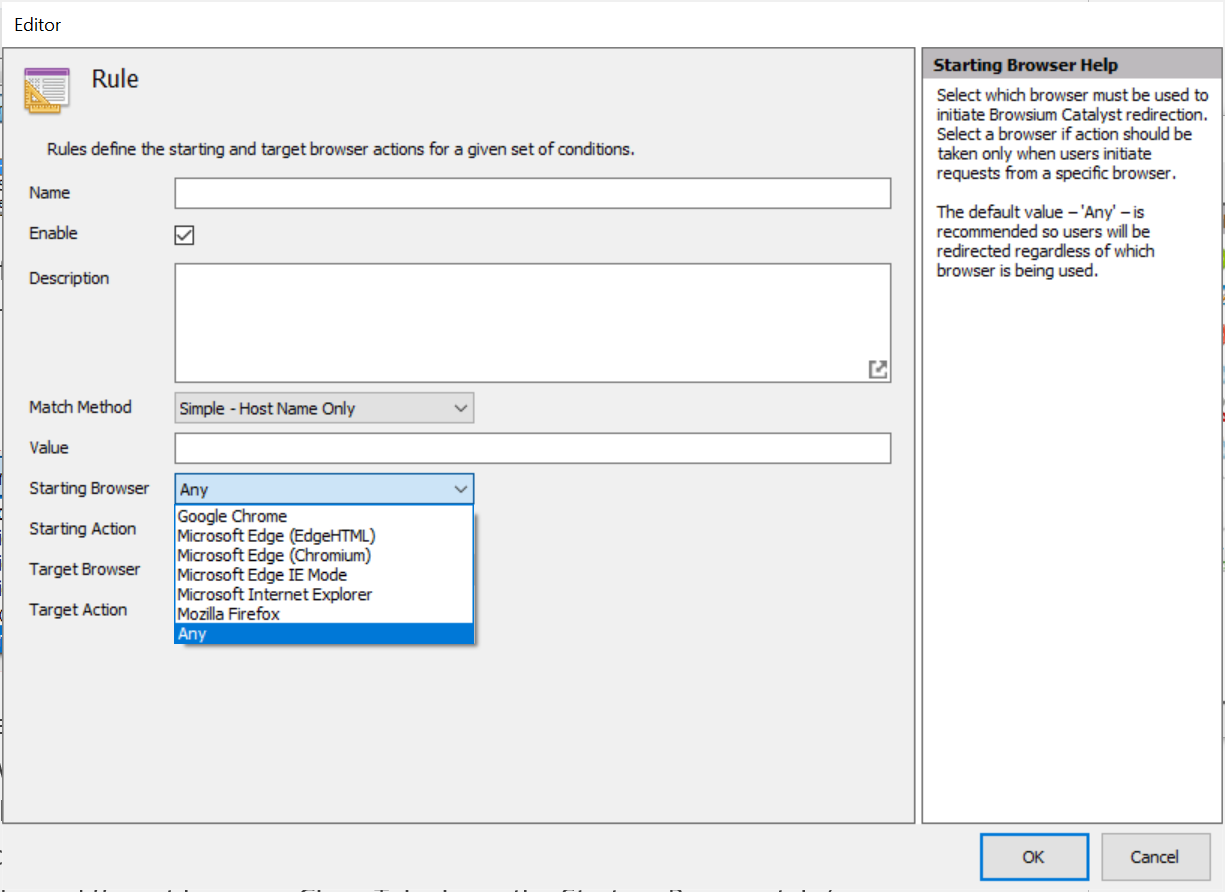
Starting Action — This field defines the Starting Browser navigation behavior. Same Page instructs the Starting Browser to cancel the desired navigation and remain on the current page, while opening the new URL in the Target Browser. Redirect navigates the Starting Browser to a redirection page (which can be customized by Catalyst admins), informing users as to why their navigation action opened in a different browser. Close Tab closes the Starting Browser tab (or entire browser if only one tab is open) as it navigates the Target Browser to the desired URL.
Target Browser — This field defines desired browser that will load the web page when the rule is triggered by the navigation action performed by the end user. When Target Browser is set to ‘None’, the navigation action will be aborted, effectively blocking end user access to that URL. When Target Browser is set to ‘Any’, the matching URL will be allowed in every browser, even those that have ‘Block Other Requests’ enabled.
Target Action — This field defines the Target Browser navigation behavior. New Tab opens the page in a new tab. New Window opens the page in a new window. New Session opens the page in the specified browser using a new user session.